
Whose Story Is It? How to Tell Community Stories with Honesty and Integrity

Feb 12, 2025
5 min read
Updated: May 11
By Paula Alvarado
Category: Communications and Storytelling
Estimated read time: 5–6 minutes
Every organisation working in international development, conservation, or social justice tells stories. It’s part of the work — communicating impact to donors, building public support, making the case for funding. Most organisations do it with good intentions.
But good intentions are not enough.
After 25 years of working in strategic communications across Indigenous rights, climate, humanitarian response, and global health, I’ve seen the same pattern repeated more times than I can count. An organisation wants to tell the story of a community they work with. They send a photographer and a writer. They collect testimonials. They produce a campaign. The images are striking. The quotes are moving. The donors respond.
And somewhere in the process — often without anyone noticing — the community becomes a backdrop. Their complexity disappears. Their agency is reduced to gratitude. Their story is no longer theirs.
This is not malicious. But it is harmful. And it is avoidable.

Why it matters more than ever
The communities at the centre of so many organisations’ work — Indigenous peoples, local communities, frontline defenders — are not passive recipients of aid or conservation. They are political actors, knowledge holders, and leaders. Many of them have been fighting for their rights, their territories, and their survival for generations. When we reduce them to victims in need of saving, we misrepresent reality, undermine their authority in the very spaces — policy forums, donor meetings, international negotiations — where they most need to be taken seriously, and reinforce the same power dynamics that got us into these crises in the first place.
Honest storytelling is not just an ethical responsibility. It is a strategic one. The organisations that get this right build deeper trust with the communities they work with, produce more credible communications, and — ultimately — create more durable impact.
The evidence bears this out. Research on narrative and persuasion consistently shows that audiences — including sophisticated donors and institutional funders — are more moved by specific, honest, complex stories than by simplified emotional appeals. The Bond Ethical Guidelines on communications in development, and Africa No Filter’s work on narrative justice, both document the same finding from different angles: stories that respect the agency and complexity of the people in them are not only more ethical — they are more effective.
Start with consent — real consent, not assumed consent
Informed consent means more than asking permission to take a photograph. It means explaining clearly how the story will be used, who will see it, what platform it will appear on, and what the potential consequences might be — including risks to safety or privacy that the organisation may not have considered. It means accepting when the answer is no. And it means returning to communities with the final content before it is published, not after.
Ask whose interests the story serves
This is the most uncomfortable question — and the most important one. Before you commission a story, ask yourself: is this story designed to serve the community’s goals, or the organisation’s fundraising targets? The two are not always incompatible. But when they pull in different directions, the community’s interests should take precedence. If a story would embarrass, expose, or misrepresent the community in any way — even unintentionally — it should not be told.
Show complexity, not caricature
Communities are not homogeneous. They contain internal disagreements, competing interests, difficult histories, and multiple perspectives. A story that flattens this complexity — presenting a single voice as the community voice, or a single moment as the whole story — is not an honest story.
The most powerful stories I have worked on are the ones that held complexity without losing clarity. They showed people in full — not as heroes or victims, but as human beings navigating difficult circumstances with intelligence, determination, and sometimes humour. This is not harder to communicate than a simple narrative. It is harder to produce. The difference is in the quality of the relationship and the time invested in getting it right.
Centre agency, not suffering
There is a persistent tendency in development and conservation communications to lead with suffering — the drought, the displacement, the loss. Suffering is real and it matters. But a story that begins and ends with suffering strips people of their agency and reduces them to their hardship.
The communities doing the most important work in the world are not defined by what has been done to them. They are defined by what they are doing — protecting territories, rebuilding governance systems, defending rights, creating new futures. Lead with that. The suffering provides context. The agency is the story.
Give credit, share control
If a community’s knowledge, images, or story contributes to your organisation’s communications, they should have meaningful input into how it is used — and ideally the right to approve or reject the final product. This is not just about ethics. The people closest to the story are also the people who know it best. Their editorial input will make your communications more truthful, more nuanced, and more credible.
A note on photography
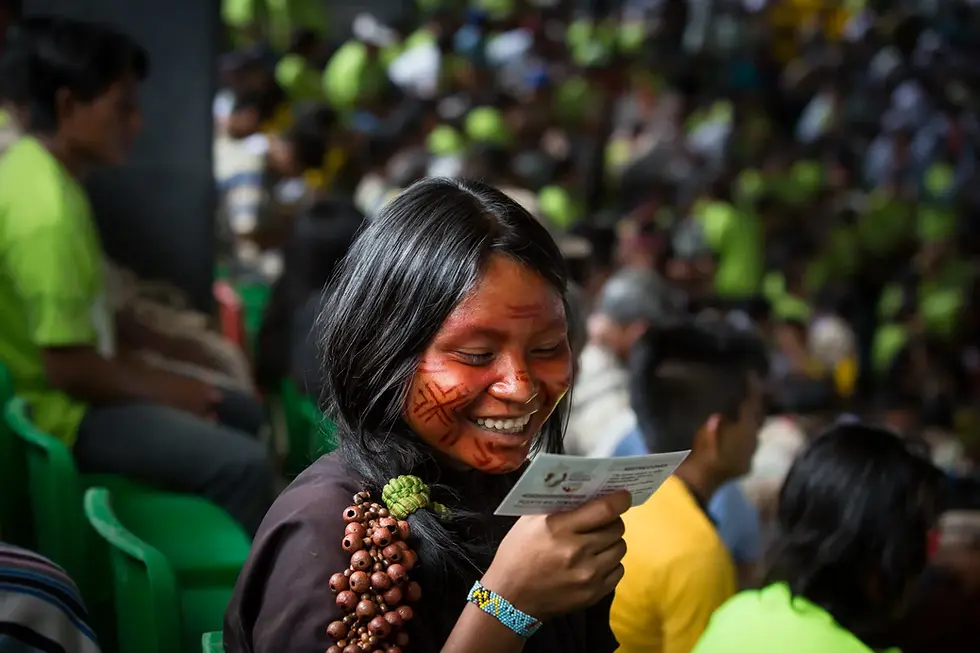
Images carry enormous power — and enormous risk. A photograph of a community can circulate globally, be used out of context, and outlast the relationship that produced it by decades. Before commissioning photography in community settings, ask: would the people in these images recognise themselves in the story being told? Would they be comfortable with how they are being portrayed? Have they seen the images and given their approval? The Bond guidelines on ethical visual storytelling and Africa No Filter’s handbook on narrative justice are two resources I return to regularly on this — both are available on the Seeds of Practice page.
Where to start
If you are not sure where your organisation stands on this, three questions are worth sitting with. Do communities have meaningful input into how their stories are told — or are they consulted after decisions have already been made? Does your communications content show communities as active agents in their own futures — or primarily as the beneficiaries of your organisation’s work? Would the people in your stories — if they read them, watched them, or saw them — feel accurately and respectfully represented?
If the answers make you uncomfortable, that is a useful starting point. The goal is not perfection — it is honest, ongoing attention to whose story you are telling, and why.



Comments